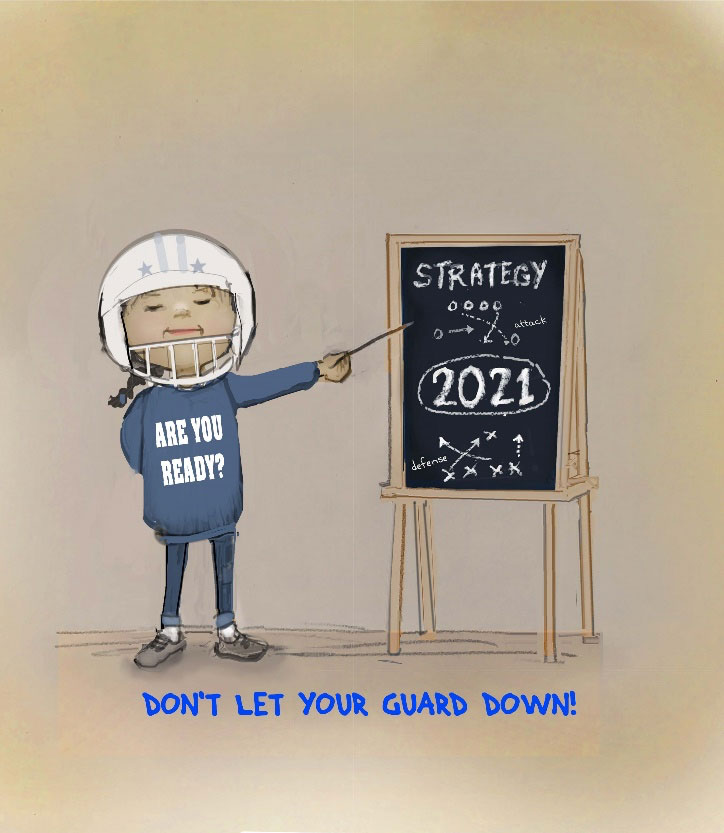
Author/Illustrator Goal setting for Success in 2021
By Dow Phumiruk
Hello! So here we are at the end of this stupendously strange and difficult year. I hope you’ve gone easy on yourself all year long, as it’s been all about survival and not so much productivity, in my opinion! But looking into next year, let’s see what we can do to rise from the mess that was 2020.
I always set goals. But there is an art to goal setting! You must set different tiers of goals. And the first two tiers must be within your realm of control, not relying on luck or another person’s interest in your work, or anything at all that you cannot make happen.
Set 1: Achievable, inspirational, confidence- and wellness- boosting goals
Oh yes. These are fun! There is a parallel with people who like this set to those of us who make lists and add items just so that we can immediately cross them off. But do it. It brings that fresh feeling of accomplishment. Here are some examples:
- Draw a holiday image in celebration
- Share the holiday image on social media, or better yet: send it to a blogger like Kathy Temean who posts holiday image threads regularly. Here is her most recent holiday post for Thanksgiving as an example.
- Try a new technique in art, illustration, or crafting. Anything new to rejuvenate those creative muscles! Here are some ideas:
- Try new tools (oil paint sticks, white gel pens on brown or dark paper, etc). In digital art such as in Photoshop, search a tool or adjustment layer that you’ve haven’t used often if at all, and see what it can do! You may find yourself using it regularly after some quick research. Watch a Procreate tutorial or try an inexpensive new digital drawing app. I bet you’ll learn something new!
- GIF making: it’d been a while since I had created a GIF, and I reacquainted myself with how to do so on the iPad. It’s relatively easy. My tip: try not to animate too many parts!! You start seeing how you can move a character, but when you do so, it ends up being a 40-layer file (close to the maximum number of layers allowed on Procreate). Instead, draw a nice character and animate just an extremity or text. It’s fun!

A quick good night GIF I sent to my daughter at college
- I saw a friend post about making little dolls using honeycomb paper (wooden beads for heads and the honeycomb paper for their bodies/dresses). Here is a sample of ornaments made with honeycomb paper! Another friend and Cuddlefish member, Heather Brockman Lee, is creating super fun paper engineering projects like this one. What a great idea and challenge that is!
- Speaking of 3D materials, what about air-dry clay? I like white Crayola brand clay (other artists I know enjoy Sculpey clay) and find it can be super fun to design your characters in 3D. Take time to visit or revisit this craft. You’ll have a lasting souvenir of your endeavor!
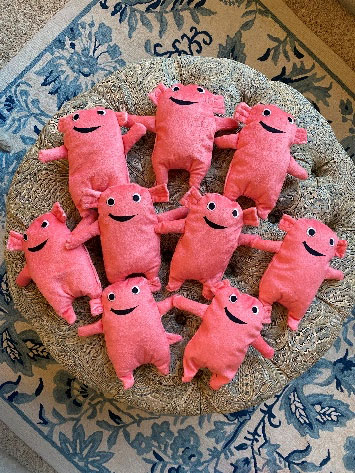
- Custom fabric: For the first time, I custom-printed fabric with stuffed doll patterns on them. The doll character, a pet monster, is from my latest book. The patterns included faces, so this made assembling the stuffed toys very easy. They make a nice pairing with my book. Keep your outlines for the pattern faint, like in my sheet of Hugsbies here (hard black outlines may show in the finished project if you don’t sew the seams precisely).
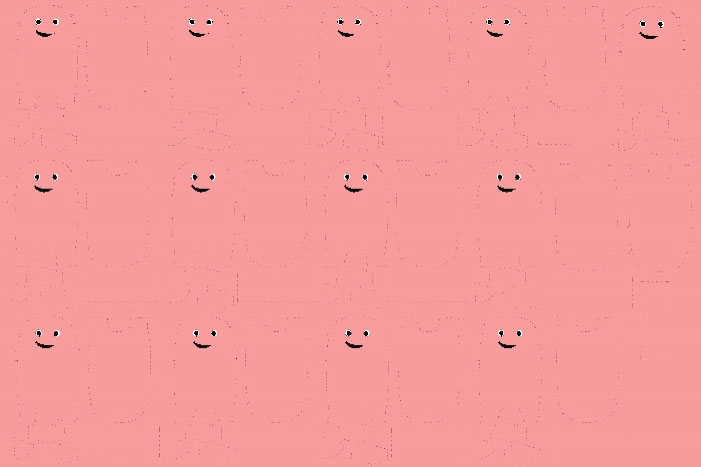
Think on how ordering custom fabric with your design could work for marketing your project. It is very simple to print squares of art to sew into a small throw pillow, for example. I order from Spoonflower.com. Keep in mind, though, that their fabric is not super cheap, and rarely are there sales. Stick to basic cotton if that will fit your needs.
- For wellness, please do make time for exercise. A little every day would be especially good in the setting of our sedentary lifestyles as writers/illustrators. Regular exercise is a great goal!
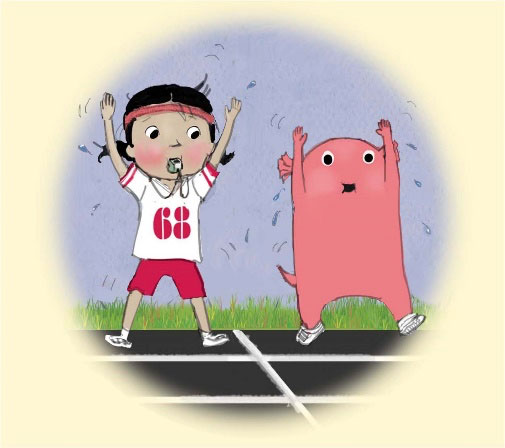
From Hugsby, back endpapers, copyright Dow Phumiruk
Set 2: Real Work!
Here you want to set some goals that will move you along in the direction that you want your career to go.
- As an author/illustrator, three new dummies in the next year is a great goal. Three! That is not a big number, though I will agree that writing a story and then sketching the dummy are no small feats. Start with idea-churning. I like recommending January’s Storystorm from Tara Lazar to help with finding new ideas. I don’t join for the giveaways, but you could (it takes time, so I just skip). After the month of January, sift through and choose your best few. Start writing stories for those. In March, June, and September (you can pick the months!), create a dummy for three of those ideas. The goal in this business is to KEEP MOVING, and by this I mean keep creating. The act of creating over and over will soon result in that one great project – or two, or three. I think putting a teensy bit of pressure on yourself can work wonders here. Pick one of your ideas (the Rockefeller tree owl who found himself transported from upstate NY to NYC might be a popular one this year) and set aside an hour to write the story. One hour. On the clock. Sit and write. That’s it. It doesn’t have to be great.
- As an illustrator, set a goal of new portfolio images. One every other month is a realistic number.
- If you are a writer, would you like to try a new genre? This year I will be attempting a chapter book. Maybe you’ll want to try a novel in verse. If so, set a goal to start by reading x number of books in this format.
- What about improving a certain aspect of your art or writing? One year I made a goal of drawing as many elbows as possible. How about ears, noses, or hands? Any focus and repeated efforts in one area should result in growth. You can set a concrete number: “In 2021, I will draw 25 completely new types of background scenes.” In writing, you can read about successful picture books and try mimicking them in your own work. A concrete goal would be: “I will read 50 mentor texts in my genre of choice to study character arcs.”
- Marketing: you’ll need to get your work out there, whether or not you are ready for publication.
- You will want to establish a social media presence to show your support of the children’s lit community. This is a good place to start if you have not yet done so. Be active once a week. That’s really all it takes, and don’t go down any rabbit holes while you are being “social.” Find industry professionals to follow, comment, like or heart – I think this part is most important, so people will know you are interested and engaged in the kid lit community. You’ll also get to know them through what they share, and this can rule in or rule out particular agents or editors you might have under consideration for submitting to. Share interesting articles. Search for hashtags that will relate to children’s books such as #childrensbooks, #kidlit, or #illustration (you can find inspiration in any type of art, really!). Visit social media in an intentionally professional way as a break from work on just that one day a week. I like to think of it as hopping out to put positive energy out into the world, to cheer others on, or to share your own joys. One day it’ll be to share your own good news about representation or new book deals! Invest now in building your future marketing base. It is free!
- Participate in regular challenges. The Cuddlefish group tries to participate in #Colour_Collective. It’s still one of my favorites, because the guidelines are very loose. Just include the color of the week in your art that week, posting on Fridays around noon with this hashtag on Instagram or Twitter. Now though I list this is under marketing, don’t try to worry too much about how many likes or hearts it gets or does not get. It’s part marketing and part for you to be accountable in productivity. Try not to feel the need to garner external sources of validation. If you hit a high note and happen to get extra attention for a piece of art, study what features made it successful and work in that direction. And then don’t forget to go like/heart or share other artist posts.
- When you are ready, submit to agents or editors you’ve researched. Depending on how many projects you have ready to go, you may choose to submit to one agent or editor every two to three months. Ideally, once you have submitted a project, you move on to the next project. Do not dwell on your single project. I used to do that. Refreshing that email inbox in hopes of a positive response to your submission is time wasted, my friend. Move on to something new.
Set 3: The Starry-eyed Dreaming….
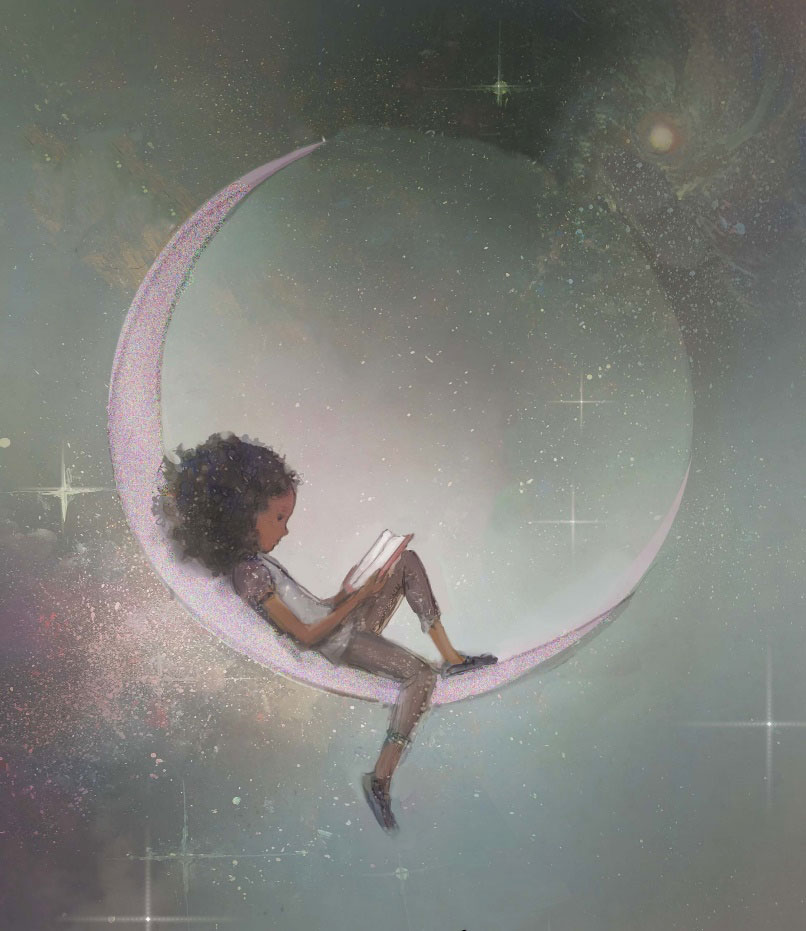
Here are your reach goals. Choose whatever lofty goals you like to see reached, and write them down. If you are unpublished, then maybe you hope to be published, for example. Note that unlike in Set 1 and 2, some of these dream goals can be out of your control. You must wait for a publisher to offer a contract on your project. You must wait for an agent to choose to represent you. You must wait for the Caldecott Committee to choose your book. But you can choose any whimsical goal you would like to! It’s completely up to you! My randomly dreamy goal for 2021, for example, is to be paired up with a celebrity author. Just for fun. Just because!
And that is how you break down to write down your goals for 2021. Will you reach them all? Probably not! But that’s okay!! Will some of these goals be revisited next year? Quite possibly! And that, too, is okay. We are all on different timelines to success. But keeping a framework of what you’d like to see accomplished is one way to actually be on track to accomplish more.
Good luck, happy holidays, and wishing all of us a 2021 that is much more palatable than this year has been.
Twitter and IG: @dowphumiruk
Facebook: Dow Phumiruk Ng
Portfolio: www.artbydow.com Blog: www.happydow.blogspot.com

 The Cuddlefish Gang: Together We Can Do AnyFIN!